The Pilates industry is currently experiencing a significant surge in demand. Recent industry reports from Allied Market Research project the global Pilates and yoga market to reach over $520.6 billion by 2035. For studio owners, this growth represents a massive opportunity, but profitability is not guaranteed by popularity alone.
Making a Pilates studio profitable requires moving beyond the role of an instructor and adopting the mindset of an operational leader. This means understanding how to balance the high cost of specialized equipment and certified talent with a pricing strategy that reflects the premium nature of the service.
Consider this your guide to refining your Pilates studio business model and implementing the operational changes necessary to ensure long-term financial health.
Key takeaways for a profitable Pilates business
- Choose a studio model that fits your clients, space, and equipment budget.
- Forecast revenue and running costs, including instructor pay, then calculate break-even and plan a cash reserve.
- Plan how you’ll attract new clients and help them become regular members.
- Diversify your income with offerings that suit your studio, such as workshops, retail, or online classes.
- Simplify bookings, payments, and follow-up so you can spend more time with clients.
Build your Pilates studio business plan in 7 steps
Your Pilates studio business plan should serve as an operational blueprint that dictates how your studio will generate revenue while managing high fixed costs, like specialized equipment and certified talent. To ensure long-term health, your plan must move past general goals and focus on the specific financial levers that drive profit in a boutique setting.
Follow these direct steps to build a plan that prioritizes execution and efficiency:
1. Choose your Pilates studio model and plan your setup
The first section of your Pilates business plan should define your revenue model. The key is to choose a business model that fits your space, equipment budget, and the clients you want to welcome into your studio.
Here are three common approaches and what each means for your setup:
- Private-heavy model: Focus on one-to-one sessions. You may be able to start in a smaller studio with fewer pieces of equipment, though per-client teaching costs can be higher.
- Group reformer model: Build revenue through classes with several clients. Each place needs a reformer, so plan your equipment investment and layout together. Set attendance targets using your costs and pricing.
- Hybrid boutique model: Combine group classes with private sessions to spread your income across both formats. Plan for any overlap between classes and private appointments.
Your chosen model will help you determine the space you need. Before you commit to a location, though, consider accessibility for your target clients and whether rent fits your budget.
Also consider usable teaching space after accounting for reception and storage areas, and allocate space to move comfortably around equipment. List the equipment you’ll need at opening, and set the class capacity to what your layout can comfortably support.
2. Plan instructor costs as a share of revenue
Profitability in a pilates studio is heavily dependent on payroll efficiency. Your business plan should include strict guidelines for coaching costs to prevent them from absorbing your margins.
Here’s what to do:
- Set a 40% cap: Plan to keep direct coaching costs at or below 40% of the revenue generated by any specific session.
- Build a performance-based pay scale: Outline a structure that rewards instructors for high-occupancy classes to align their goals with the studio’s success.
- Automate non-teaching tasks: Use software to handle scheduling and billing so you’re not paying instructors or admin staff for tasks that technology can perform.
Documenting these ratios in your plan provides a clear benchmark for success as you begin to hire and scale your team.
3. Define your market position and plan how to attract clients
Your Pilates studio business plan should explain who you want to welcome and why they’ll choose your studio. From there, plan how you’ll help those clients discover your classes and make their first booking. Here’s what to include:
- Conduct a competitor audit: Review nearby studios’ prices, class formats, and popular class times. Look for needs you could meet, such as beginner group classes where local options focus on private sessions.
- Define your unique selling point (USP): Identify what makes your studio memorable, whether that’s a signature class format, specialist teaching, or a welcoming atmosphere. Carry that message through your marketing.
- Profile your ideal client: Consider their goals, preferred class times, and how they find local classes. Use those details to shape your schedule, offers, and messaging.
- Choose how you’ll reach them: Focus on two or three channels suited to your audience. Consider a Google Business Profile, social posts showing your classes, or partnerships with nearby wellness businesses. Give each channel a clear route to your booking page. Record where each inquiry comes from so you can compare results.
- Plan the first booking: Offer a clear starting point, such as a beginner class or an introductory class pack. Set a monthly marketing budget you can sustain and a target for turning inquiries into paid first bookings. For example, a planning target could be 10 paid first bookings from 40 inquiries in a month, a conversion rate of 25%.
Use this plan to focus your time and spending on the people most likely to join your classes.
4. Diversify your studio’s revenue streams
Relying solely on group class revenue is a bigger risk than you may realize. Your Pilates business plan should always outline how you’ll maximize every square foot of your studio and every hour of your digital presence.
Diversifying revenue streams for your Pilates studio typically looks like this:
- Integrate fitness marketplaces: Use platforms like ClassPass or Wellhub strategically. Your plan should specify using these to fill off-peak spots, instantly increasing your studio's visibility without cannibalizing your full-price memberships.
- Launch a curated web shop: You don’t need a massive retail footprint. A curated selection of branded grip socks, mats, and wellness products adds value and increases the average basket size per customer.
- Introduce Video on Demand (VOD): Plan for a hybrid revenue stream. Using VOD integrations like YouTube or Vimeo through your management software allows you to monetize your content for clients who travel or prefer home workouts.
- Offer high-margin workshops: Include a schedule for specialized events like "Intro to Reformer" or "Pilates for Runners." These sessions often bring in more revenue per hour than standard classes and offer a clear path for upselling engaged clients.
By diversifying your income, you protect your studio’s bottom line against seasonal dips in class attendance and create a more resilient financial future.
5. Build your Pilates studio’s financial plan
Bring your projected revenue and expected costs together in your Pilates studio business plan. Include opening costs if you’re starting out, then forecast income and spending month by month over the next 12 months.
| Cost type | What to include |
|---|---|
| Startup costs | Lease deposit, equipment, renovations, permits, and launch marketing |
| Monthly running costs | Rent, scheduled instructor pay, insurance, software, utilities, cleaning, maintenance, and marketing |
| Costs per visit | Payment fees, consumables, and any instructor pay linked to attendance |
For an illustrative example focused on group classes, consider eight reformers and 100 classes a month, giving you 800 available places. Assume monthly fixed operating costs of $8,000, including instructor pay for that schedule, plus $5 per paid visit. Average revenue per visit is $25 after membership and class-pack discounts.
- Monthly revenue at 500 paid visits: 500 × $25 = $12,500.
- Operating profit: $12,500 − $8,000 − (500 × $5) = $2,000, before tax and financing.
- Monthly break-even: $8,000 ÷ ($25 − $5) = 400 paid visits, or 50% of available places.
For your full forecast, add projected income and associated costs from private sessions, workshops, retail, and any other planned offerings. Also map when payments arrive and when bills, taxes, and loan repayments fall due.
If your forecast shows a $2,000 monthly cash shortfall for three months, allow another $6,000 plus a buffer on top of startup costs. Track recovery of your opening investment separately.
6. Simplify your studio’s operations
The "Operations" section of your plan isn’t just about day-to-day tasks; it’s about how technology protects your time and profits. The smoother your backend, the more bandwidth you’ll have to focus on growth and high-impact client experiences.
To optimize your operations and studio efficiency, do the following:
- Leverage an all-in-one platform: Using dedicated Pilates studio software saves you time by letting you manage bookings, payments, CRM, and analytics in one place. It removes the headache of spreadsheets and booking errors, so you can focus on your clients.
- Automate the "busy work": Set up automated reminders, payment collections, and onboarding sequences. Software that handles these routine tasks saves you hours of manual labor while creating a smooth, personalized experience for your members.
- Maintain high-quality assets: Your equipment is a depreciating asset that requires a maintenance schedule in your plan. Investing in durable gear from the start saves you thousands in repairs and prevents the downtime that kills studio momentum.
Prioritizing operational efficiency through automation ensures your studio runs like a professional business rather than an exhausting manual labor project.
7. Set growth goals and strengthen client retention
Profit today is meaningless if you aren't planning for tomorrow. This final part of your business plan ensures your studio is resilient enough to thrive in a shifting fitness landscape and keep members on the mat.
To build that resiliency, here’s what you need to focus on:
- Building a "tribe" through community: Retention is cheaper than acquisition. Plan for in-studio events, seasonal challenges, and referral programs like "bring a guest." These build an emotional investment that keeps members from switching to a cheaper competitor.
- Setting measurable OKRs and KPIs: Don’t just hope for the best. Map out your Objectives and Key Results, like hitting 75% class occupancy or a specific monthly revenue target. Use KPIs to track your progress in real-time so you can course-correct quickly.
- Staying agile and informed: The industry moves fast. Your plan should allow for "pivots"—whether that’s testing a new class style or adjusting your pricing strategy based on seasonal trends and client feedback.
By embedding retention and long-term goal setting into your operational model, you move from a mindset of survival to a strategy of sustainable, scalable success.
How your Pilates studio business model shapes your plan
Earlier in step one, we talked about choosing an operational model that aligns with your revenue model. How your Pilates studio generates revenue is what will define the financial levers you need to pull to stay profitable. Your business model needs to reflect these distinct realities, because a strategy designed to fill a 15-person reformer class won’t work well for a studio that relies on private, one-on-one clinical work.
To help you visualize how these strategies shift in practice, the table below compares how your primary business model dictates your specific planning focus and operational priorities:
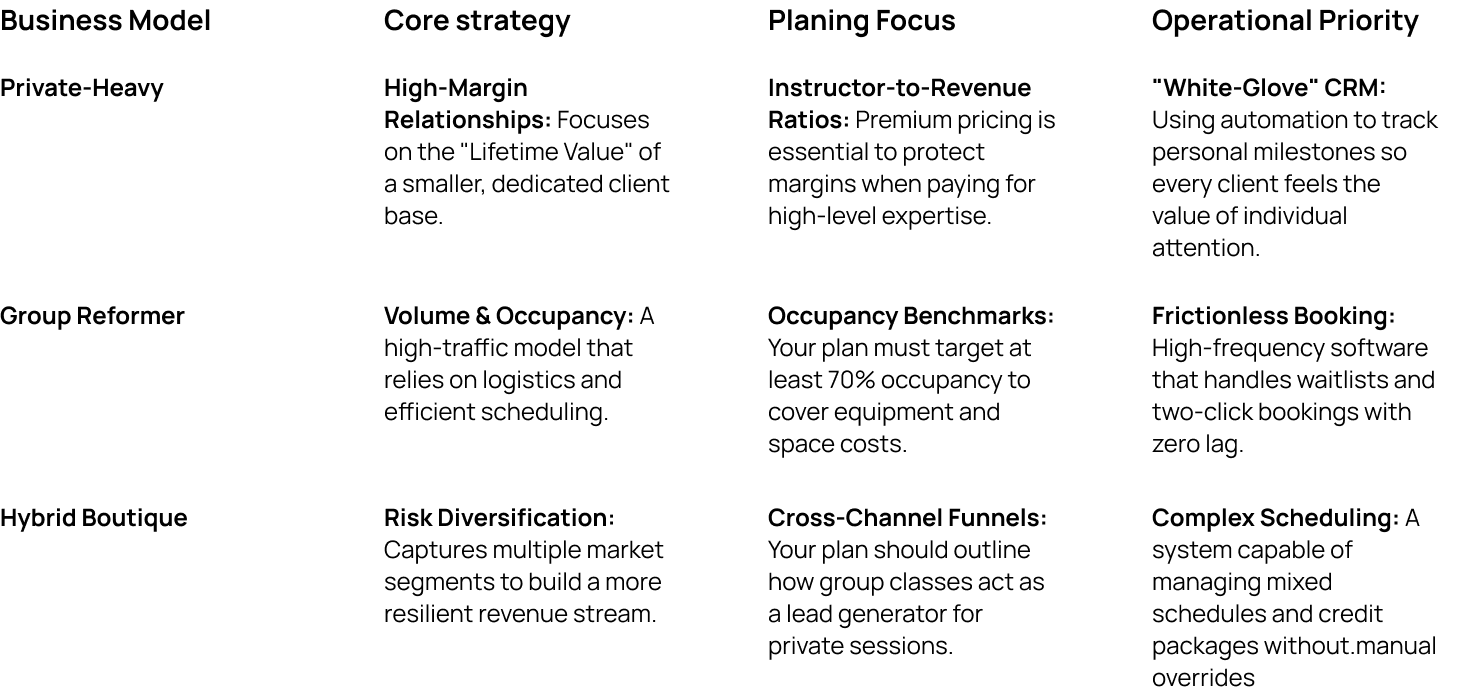
By mapping your plan to one of these specific frameworks, you ensure your operational decisions directly support the way your studio actually generates profit.
Put your Pilates business plan into action
Your studio business plan will only work if it translates to daily action. By focusing on specific levers like instructor ratios, revenue architecture, and automated retention, you can create a solid strategy built for execution and success. As your studio evolves, use these steps as a recurring audit to ensure your operations still align with your financial targets.
This process is much easier when you aren't fighting with multiple apps or spreadsheets. bsport is an all-in-one studio management and marketing platform that acts as the operational backbone for your entire business. By combining your bookings, payments, and CRM into one system, the platform automates the routine admin that usually eats into your margins. This gives you the real-time data needed to optimize occupancy and scale revenue without adding to your daily workload.
Ready to put your business plan into action? Explore how bsport's Pilates studio software gives you total operational control to support your studio's long-term financial health.