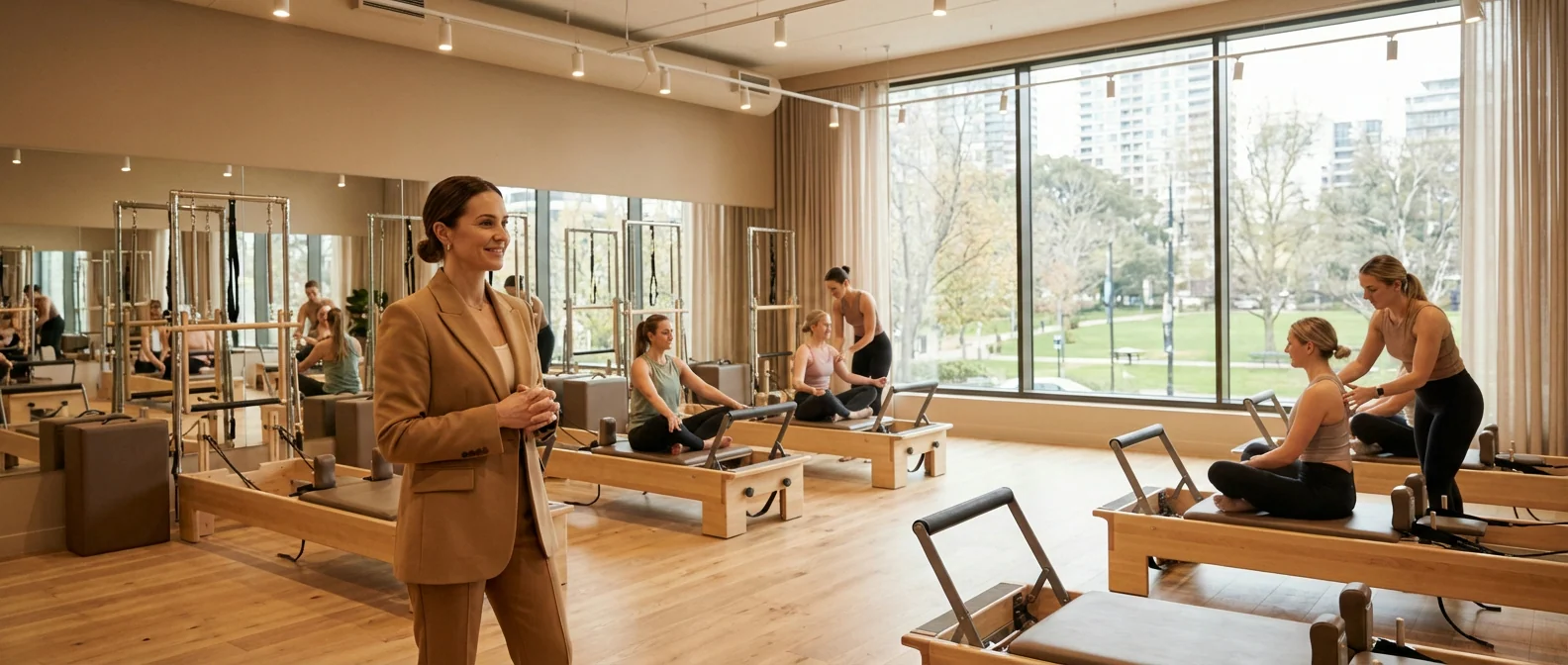
Opening your own studio is a dream for many trainers and fitness enthusiasts: you design your own offering, build a community, and create a place where people truly feel good.
At the same time, “starting a fitness studio” isn’t just a passion project—it’s a business. Without a clear model, solid planning, and structured processes, great training can quickly turn into constant operational stress.
In this article, you’ll get a structured overview of how to start your own fitness studio, with a focus on boutique concepts. You’ll learn how to assess your business model, develop a solid concept, build a fitness studio business plan, understand key cost drivers, and navigate legal requirements.
Key takeaways
- Start with a clear studio concept based on local demand, a defined target audience, and a class experience that sets you apart.
- Build a business plan that covers startup costs, ongoing expenses, funding, projected revenue, and your break-even point.
- Choose a space that suits your classes and members, and confirm the lease, zoning, renovation, and insurance requirements before committing.
- Hire qualified instructors and set up clear routines for bookings, payments, cleaning, timetable changes, and member support.
- Build interest before opening, then track attendance, retention, class occupancy, and revenue to guide future decisions.
Understanding the fitness studio as a business model
If you want to start a fitness studio, you first need to understand how you actually make money.
It sounds simple—but it’s often overlooked: your product is not “training,” but a reliable experience that members book regularly, attend consistently, and recommend to others.
Boutique studios operate differently from traditional gyms. You’re not selling square meters—you’re selling focus, quality, and community.
This brings strong advantages—but also clear requirements when it comes to positioning and planning.
Check local demand before starting a fitness studio
The fitness market is highly competitive in many cities. At the same time, opportunities emerge where people no longer resonate with “something for everyone.”
Boutique concepts work especially well when you occupy a clear niche:
- Yoga
- Reformer Pilates
- Barre
- HIIT
- Indoor cycling
- Functional training
- Mobility
- Hybrid concepts (e.g. workshops, retreats)
Three signs of local demand
1. Target audience density
Are there enough people within a 10–20 minute radius who match your target group? This matters more than total population.
2. Willingness to pay & lifestyle
Boutique models often rely on premium pricing. You need an environment where quality, service, and atmosphere justify the price—and where your audience values these things.
3. Gaps in the current offering
Competition isn’t bad—it proves demand exists. What matters is whether you can clearly stand out.
👉 Practical tip:
Don’t rely only on Google Maps. Book classes in 3–5 local studios. Observe occupancy, waitlists, pricing, and member experience. You’ll learn more in two weeks than from hours of research.
Studio concepts and positioning strategies
“Starting your own fitness studio” can mean very different things. Your model determines your costs, staffing, and marketing.
Boutique fitness studio models
- Class-based studios (e.g. yoga, reformer, cycling)
- Small group / semi-private training
- Personal training studios
- Hybrid models (classes + PT + workshops)
Positioning means deciding what you stand for—and what you don’t.
A useful test:
“We are the studio for ___ who want to achieve ___ without ___.”
If you can’t clearly fill in that sentence, you’ll struggle later with pricing and marketing.
Building a strong studio concept
A concept is not just “we offer Pilates.”
It’s a system:
Target audience → Offer → Pricing → Capacity → Processes
The more clearly you define this upfront, the smoother your operations will be after opening.
Target audience, offering, and brand strategy
Many founders start with classes and hope people will come.
A stronger approach: define your audience first—then build your offer around them.
Fitness studio target audience examples
- Busy professionals with limited time
- People seeking low-impact training
- Advanced athletes focused on performance
- Beginners who feel uncomfortable in traditional gyms
From this, define:
- Core class formats
- Level structure
- Retention drivers (challenges, workshops, etc.)
Your class schedule is your revenue engine—yet often poorly structured.
Your brand strategy is also practical:
How does your studio feel?
What tone do you use?
What standards apply?
Consistency is key in boutique fitness.
Set your studio apart and choose a pricing model
In boutique fitness, competing on price is rarely the right move.
You differentiate through focus and quality—and your pricing should reflect that.
Questions to define what makes your studio different
- What do you do better or more clearly?
- What is your signature element?
- How do you simplify onboarding and return visits?
Fitness studio pricing models
- Memberships (most stable)
- Credit systems
- Class packs
- Drop-ins
Just as important as pricing:
- Booking rules
- Cancellation policies
- Waitlists
- No-show handling
These “details” determine whether your operations run smoothly—or become manual chaos.
Write a business plan for your fitness studio
A business plan isn’t just for banks—it forces you to test assumptions:
- How many members do you need?
- What occupancy is realistic?
- What costs will hit early on?
Work out startup costs, funding, and your break-even point
Startup costs vary depending on size, concept, and location.
One-time and ongoing fitness studio costs
- Location & build-out
- Equipment
- Launch marketing
- Working capital
- Software & systems
Plan realistically—and include buffers.
Ways to fund a new fitness studio
- Personal capital
- Bank loans
- Grants
- Investors
How do you know if a fitness studio is profitable?
Use a break-even calculation based on:
- Fixed costs
- Variable costs
- Revenue per member
- Occupancy
Be conservative. Build best-case, realistic, and worst-case scenarios.
Choose and set up your fitness studio space
Your space should suit the members you want to reach and the way you plan to run classes.
Look beyond rent. Check visibility, public transport, parking, nearby businesses, and local competition. Visit the area when your busiest classes run to see what access is really like.
Check the space before signing a lease
Confirm that:
- Local rules allow the space to operate as a fitness studio
- The lease covers your planned opening hours, signage, and renovations
- The flooring, ceiling height, power, ventilation, and acoustics suit your classes
- Members and instructors have enough room to move safely
- There's practical space for reception, storage, and changing areas if needed
Get quotes for any building work before you commit. A low rent can quickly become expensive if the space needs major changes.
Plan the space around your classes
Start with the experience you want to deliver.
Yoga and barre studios need open floor space, storage, lighting, and good sound. Reformer Pilates, cycling, and strength studios need more equipment, power, ventilation, and delivery access.
Buy the equipment you need for your core classes first. You can add more as membership grows and you learn how people use the space.
Build recurring revenue and fill more classes
Two key principles:
1. Predictability beats one-time revenue
Memberships create stability.
2. Capacity is your limit
Boutique = limited spots.
You must optimize occupancy through:
- Scheduling
- Waitlists
- Peak times
- Trainer planning
KPIs to track as your studio grows
- Occupancy rate
- New vs returning clients
- Churn rate
- Revenue per member
- No-show rate
Growth usually starts with optimizing operations—not opening a second location.
Meet the legal and insurance requirements for a fitness studio
You don’t need a specific license to open a gym—but you must meet legal requirements.
Registration, zoning, contracts, and insurance
- Legal structure (sole trader, LLC, etc.)
- Business registration
- Lease & zoning compliance
- Contracts & terms
Professional legal support is highly recommended.
Hire your team and set up day-to-day operations
Your team shapes the experience members have in every class, message, and visit.
Start by deciding which roles you need from day one. This may include instructors, front desk support, cleaning, and a studio manager. In a small studio, one person may cover several of these jobs.
Hire for your studio and your members
Look for instructors with the right qualifications and experience for your classes. They should also communicate clearly, make members feel welcome, and reflect the standards you want your studio to be known for.
Before hiring, confirm any local requirements for instructor qualifications, first aid training, and employee or contractor status.
Set up simple routines before opening
Write down how your team will handle:
- Opening and closing the studio
- Member check-ins, waitlists, and late cancellations
- Cleaning and equipment checks
- Instructor cover and timetable changes
- Member questions, complaints, and incidents
- New member follow-up and onboarding
Set up bookings, payments, the timetable, and member records using a single fitness studio management system. Make sure everyone knows how to use it before the first class.
Keep your processes simple. A short checklist your team follows is more useful than a long manual nobody reads.
Reduce the main risks of starting a fitness studio
Common risks:
- Slow member growth
- Underestimated costs
- Overdependence on individuals
- Manual, inefficient processes
Processes that keep your studio running consistently
- Financial reserves
- Clear team roles
- Standardized operations
- Defined roadmap
Studios that implement systems early avoid operational chaos later.
Ready to start your own fitness studio?
Opening a fitness studio is a great opportunity—but only sustainable if approached as a business.
With:
- Clear positioning
- A solid concept
- A realistic business plan
- Structured processes
You gain control over costs, profitability, and growth.
Standardizing early allows you to focus on what truly matters:
member experience, community, and consistent occupancy.
Discover how bsport helps boutique studios grow in a structured and sustainable way from day one, with pre-launch signups, bookings, and payments in one place. Book a demo to see how it works for your studio.


FAQ Key things to know
How much does it cost to open a fitness studio?
There's no single figure. Your costs will depend on the location, studio size, class type, equipment, and the amount of work the space needs. For that reason, your startup budget should cover:
- Deposit, rent, and building work
- Equipment, flooring, mirrors, lighting, and sound
- Licenses, insurance, and professional fees
- Team costs, software, and marketing
- A cash reserve for the first few months
Equipment-light concepts such as yoga or mat Pilates can start with less. Reformer Pilates, cycling, and strength studios usually require more upfront investment due to their equipment and space needs.

How do you get your first fitness studio members?
Start before your doors open by creating a simple page that explains who the studio is for, where it is, which classes you'll run, and how people can register their interest. Build a local audience through social media, email, trial classes, nearby businesses, and a limited founding-member offer. With bsport, pre-launch signups let people register and book their first classes before your doors open.
Can you open a fitness studio with no money?
Opening a permanent studio with no capital is unlikely. Even a small space comes with costs such as insurance, rent, equipment, and business registration. You can start with less by teaching in a rented or shared space, running outdoor or online classes, leasing equipment, or building demand before taking on a long-term lease. Pre-sales, a business partner, grants, and small business loans may also help fund the move into your own space.