What to know about the Lagree Pilates machine: costs, layout, and capacity planning



Divide your total equipment investment by the number of spots it creates. That cost per spot is what your class pricing needs to cover.
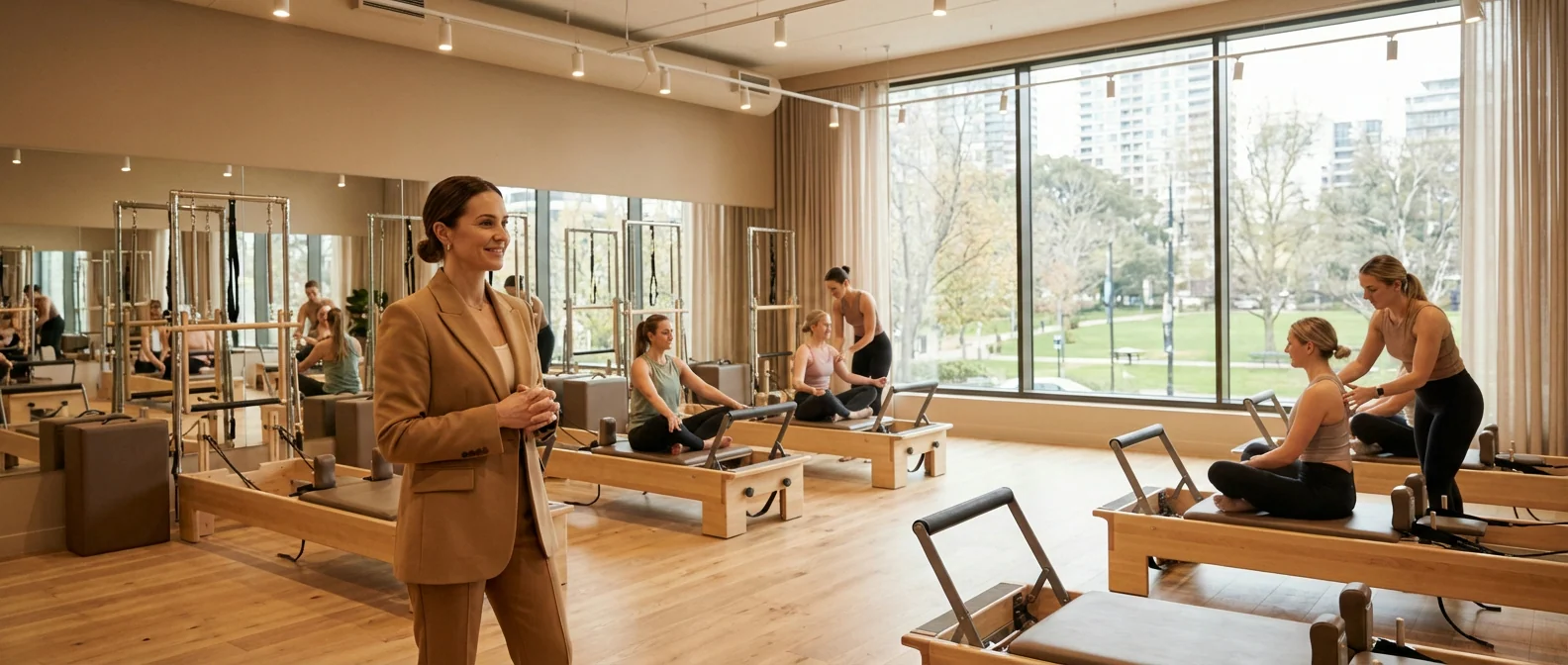
Floor space limits how many machines you can fit, and machine count caps class size, so plan the room before you order equipment.
Spot Selection, automated waitlists, and utilization reporting in bsport help keep machine-based classes full once your equipment is in place.
A Lagree studio has a fixed number of spots per class, and that number is set entirely by its machines. If you're planning to buy a Lagree Pilates machine, or a full room of them, the equipment decision shapes your costs, your floor plan, and how much revenue each class can bring in.
It's a significant investment, and it pays to plan it carefully. This guide covers what the machine is, what it really costs, how to lay out the room, and how to turn machine count into a capacity plan.
What is the Lagree Pilates machine?
Lagree classes run on machines designed and made by Lagree Fitness, rather than on standard Pilates reformers. The best-known model is the Megaformer, which looks similar to a reformer but is larger and built for resistance-based strength training.
Lagree Fitness describes Lagree as its own fitness method, separate from Pilates. It was created by fitness instructor Sebastien Lagree, who also designed the original Megaformer. Many founders still search for a "Lagree Pilates machine" because the equipment looks so similar to a reformer.
Lagree machine vs. Pilates reformer machine
If you already run a reformer studio, a few differences matter most:
- Size and footprint: full-size Lagree machines are longer and heavier than most reformers
- Resistance system: springs sit under the carriage and are adjusted throughout class to change resistance
- Class format: slow, continuous movement with little rest
- Equipment and training: Pilates reformers and Pilates qualifications don't carry over, and studios using the Lagree name need a license from Lagree Fitness
For a fuller comparison of the two methods, see our guide to Lagree vs. Pilates.
The Lagree machine range at a glance
Lagree Fitness makes several machine families. The Megaformer and EVO are full-size machines. The Mini and Mini Pro are mid-size, and the Micro is the most compact. Smaller machines fit more spots into the same room, while full-size machines offer the classic Megaformer experience. Our guide to opening a Lagree studio breaks down each model and its licensing tier.
How much does a Lagree Pilates machine cost?
Lagree Pilates machine price depends mostly on the model, but the machine itself is only part of the total investment.
Machine prices by model
Lagree's published US guidance, as of 2026, puts indicative prices per machine at:
- Micro: $600 to $2,000
- Mini: $2,490 to $5,000
- Mega Pro: around $10,000
Prices change, and UK pricing varies, so confirm current figures with Lagree Fitness or an authorized dealer before you budget.
The costs beyond the machine
The total cost of ownership includes:
- Annual license fee, set by machine category: Lagree's published US pricing runs from $990 a year for Micro to $3,990 for Mega and EVO
- Shipping and delivery, plus import duties and VAT for UK studios
- Accessories such as handles and platforms
- Flooring and room preparation
- Maintenance and wear parts, such as springs, plus regular servicing
- Equipment insurance
- Financing or leasing, if available (check current options with Lagree Fitness)
Why cost per spot matters more than cost per machine
Cost per spot connects your equipment budget to your class pricing. Divide your total investment by the number of spots it creates.
For example, with illustrative numbers: if 10 full-size machines and their extras cost $120,000 in total, each spot represents $12,000 of investment. If 15 smaller machines cost $50,000 in total, each spot represents about $3,300. The second room may charge less per class but recover its investment faster. The right choice depends on whether your pricing and location can support the equipment you want.
How to plan your Lagree studio layout
Your floor plan decides how many machines fit, so plan the room before ordering.
How much floor space does each machine need?
According to Lagree Fitness's equipment guidance, Megaformer models and the EVO need at least 100 square feet (about 9.3 m²) per machine, depending on the model. Lagree recommends that studios of 1,000 square feet (about 93 m²) or less consider smaller models.
In the same 1,000 square feet, Lagree estimates you can fit around:
- 10 Megaformers
- 13 Mini Pros
- 15 Minis
- 20 Micros
Remember that the class floor is only part of the space. Reception, changing rooms, storage, and retail all add to your total footprint.
Practical layout considerations
- Arrangement and sightlines: rows or a staggered layout should let the instructor see every member clearly
- Walkways: leave room for members to get on and off safely, and for the instructor to move around adjusting springs and correcting form
- Changeovers: plan how one class leaves while the next arrives, especially for back-to-back classes
- Mirrors, lighting, and flooring: choose finishes that suit a strength-based, low-impact format
- Comfortable spacing: the room should feel boutique, not crowded
Lagree capacity planning: from machine count to revenue
Capacity planning turns your machine count into a realistic picture of what each week can earn.
Start with spots per class
In a machine-based studio, machine count equals maximum class size, and that number doesn't flex. In a mat class you can usually add one more mat. In a Lagree class you can't.
A simple capacity formula
Weekly revenue potential = machines × classes per week × utilization rate × average revenue per visit.
Example (illustrative): 10 machines × 24 classes × 80% × $30 = $5,760 a week, or about $23,040 over four weeks.
Small changes in utilization make a big difference. Using the same example over four weeks:
- At 70% utilization: about $20,160
- At 85% utilization: about $24,480
That's a gap of more than $4,000 a month from the same room, the same machines, and the same schedule.
Why utilization matters more than adding machines
Filling the spots you already have is often more profitable than adding capacity. The most common causes of empty machines are:
- Late cancellations
- No-shows
- Classes timed outside real demand
- An unclear or slow booking process
Each of these is an operational fix rather than a reason to buy more equipment.
Building a schedule around real demand
Plan for peak and off-peak times, and remember that Lagree is physically demanding to teach, so instructor load matters. Once you open, adjust the schedule based on attendance data rather than guesswork.
Standardizing capacity across locations
For franchise and multi-location operators, consistent machine counts make it easier to compare studios fairly. Shared performance benchmarks and side-by-side utilization reporting show which locations need support and which are ready to grow.
How the right studio software protects every machine
Once your machines are in place, your booking and scheduling tools decide how full they run. These features are valuable for any machine-based format where every spot counts:
- Spot Selection: members book a specific machine in the branded member app, which suits fixed-capacity rooms
- Waitlists that convert demand: when someone cancels, the spot fills automatically
- Flexible class scheduling: run 1:1s, recurring classes, and group classes based on real demand
- Flexible pricing models: offer credit-based passes for high-demand spots alongside memberships, which ties back to your cost-per-spot plan
- Reporting: see how full each class runs and which time slots hold up
- Multi-location management: centralized billing, reporting, and staff management across studios
Ready to plan your Lagree studio with confidence? Discover how bsport's Pilates studio software helps you track revenue, plan capacity, and schedule your Lagree classes smoothly.
Lagree® and Megaformer® are trademarks of Lagree Fitness. bsport is not affiliated with or endorsed by Lagree Fitness.


FAQ Key things to know
How much does a Lagree machine cost?
Lagree's published guidance puts Micro machines at $600 to $2,000, Mini machines at $2,490 to $5,000, and Mega Pro at around $10,000 a unit. Floor space matters as much as price: about 10 Mega Pro machines fit in 1,000 sq ft, against up to 20 Micros in the same room.

What's the difference between Pilates and Lagree?
Pilates is a broad method practiced on mats and reformers, with programming that ranges from rehabilitation to strength work. Lagree is a separate method created by Sebastien Lagree and taught on its own machines, built around slow, continuous muscular tension with little rest.
Which is harder, Lagree or Pilates?
Lagree often feels more intense because of its sustained resistance and limited rest between movements. Difficulty still varies widely across class levels, instructors, and participants, so this isn't a fixed rule.
What machine does Lagree use?
Lagree classes run on machines made by Lagree Fitness. The best-known is the Megaformer, which is similar to a reformer but larger and designed for resistance-based strength training. The range also includes the EVO, Mini, Mini Pro, and Micro. Using the Lagree name and equipment requires a license from Lagree Fitness.