
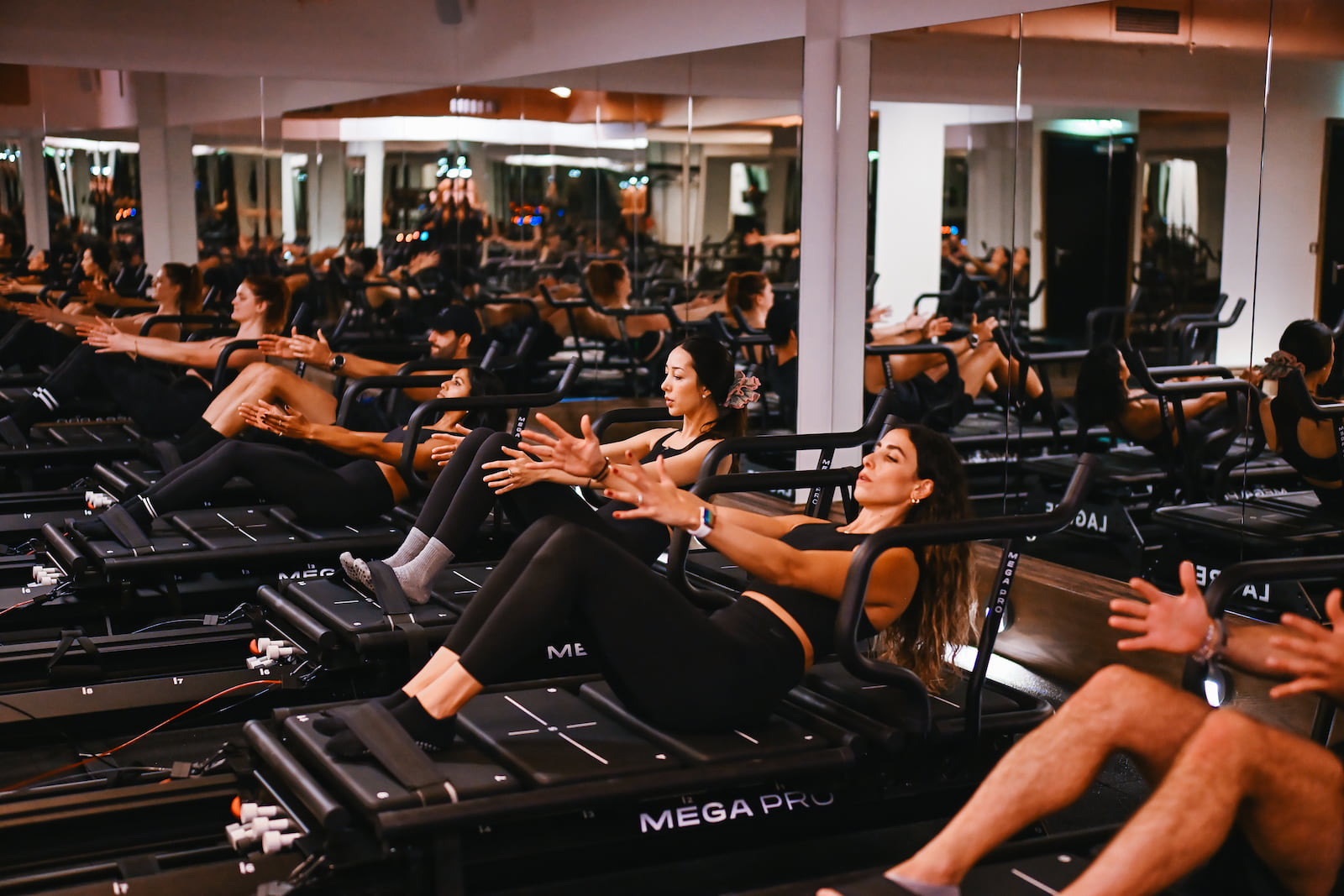

A Lagree class can only hold as many people as you have machines. Waitlists that fill cancelled places automatically and cancellation rules members understand decide how much of that capacity you actually sell.
A first-timer, a regular whose attendance has dropped, and a member with an expiring pass need different messages. Segmented communication keeps people booking without flooding everyone with the same promotion.
MAD runs two London studios from one bsport master account. Each location runs its own day, while the owners see attendance, revenue, and members across both in one place.
Every Lagree class has a fixed number of machines. That makes no-shows, late cancellations, and clunky booking more expensive than they'd be in a mat studio, because an empty machine can't be filled once the class starts.
Good Lagree studio management means coordinating schedules, bookings, machine capacity, memberships, payments, instructors, member communication, and reporting so they hold up every day. Stable operations come down to five things: protecting every place, keeping booking simple, talking to members based on their behavior, giving staff software they can learn quickly, and keeping one clear view as you add locations.
MAD, London's first Lagree studio, shows what that looks like in practice. Founded in 2023 by Mona and Nour, MAD has grown to two London studios with a 93% attendance rate across its Lagree classes.
Why Lagree studio management depends on operational stability
Operational stability is your studio's ability to run classes, support members, and coordinate your team through processes that hold up when demand, schedules, or staffing change.
It matters more in Lagree than in most formats. A full-size room might hold 10 machines, so a single empty place is 10% of that class's revenue. Small breakdowns add up fast: a cancellation nobody backfills, a double booking, an instructor change that doesn't reach members, a report that takes an afternoon to build.
When your booking, member, and payment data sit in one connected system, you spend less time fixing avoidable problems and more time on the classes and community members pay for. It also makes growth easier to manage, because each new class or location adds to a system that already works.
Five operational lessons from MAD Lagree
According to the MAD Lagree customer story, the studio has reached a 93% attendance rate across its Lagree classes, 148% revenue growth after its first year with bsport, and a 184% increase in active members over the same period. These results reflect MAD's own operating model rather than a guaranteed outcome, but the workflows behind them apply to most Lagree studios.
93% attendance across Lagree classes. 148% revenue growth and 184% more active members after MAD's first year with bsport.
1. Protect every class place with flexible capacity controls
Waitlists matter more when every machine is a fixed, time-sensitive place. If a member cancels at 6pm for a 7am class, that place should go to the next person on the waitlist automatically, without anyone at the front desk having to step in.
Configurable waitlist rules let you decide how and when members are promoted, for example up to a set time before class, so the person getting the place still has time to make it. Pair that with no-show and late-cancellation policies that are fair and communicated clearly at booking. Members accept rules they were told about upfront.
MAD uses waitlists and no-show policies together to keep attendance high. As co-founder Mona puts it:
"One of the things we're proud of is how high our attendance rates are, and bsport definitely plays a role in that."
Mona, Co-founder, MAD Lagree
To see where capacity is being lost, track attendance, no-shows, late cancellations, and waitlist movement by class and time slot. Patterns usually show up in a few specific slots rather than across the whole schedule.
2. Remove friction from booking and checkout
Members should be able to find a class, choose the right pass, pay, and get a confirmation in one clear journey, ideally on their phone.
That means accurate availability, visible membership and credit balances, instant confirmations, and relevant passes or promotions at checkout. MAD customizes its checkout with promotions and upsells to guide purchase decisions and encourage repeat bookings, which has helped its conversion rate.
MAD also uses bsport's ClassPass and Wellhub integrations to reach new clients, many of whom have become regulars. Because those bookings flow into the same schedule, the team manages marketplace and direct bookings together instead of reconciling them by hand.
3. Turn member communication into a retention tool
Targeted communication lets you respond to what members actually do instead of sending the same message to everyone. MAD tags clients with Smartlists and reaches different member groups through CoachMail, bsport's AI-powered email builder, plus push notifications and SMS.
A few practical examples:
- Welcome first-time visitors after their first class, with what to expect next time
- Check in with members whose attendance has dropped
- Remind members before a pass or class pack expires
- Suggest classes based on what someone already books
- Share offers with a clearly defined group rather than your whole list
Consistent, useful messages build stronger relationships, and stronger relationships lead to more repeat bookings.
4. Make the platform easy for staff to adopt
Hard-to-use software slows training, creates inconsistent processes, and leaves you depending on a few experienced people who know the workarounds. Before switching to bsport, MAD had to train a team of 25 to 30 people on a platform that staff couldn't learn on their own.
Instructors and managers should be able to handle everyday tasks confidently from day one:
- Viewing schedules and class rosters
- Checking members in and recording attendance
- Looking up member information
- Managing schedule changes and substitutions
Support is part of reliability too. When an issue affects a live class or member bookings, you need fast, human help from people who understand boutique fitness.
5. Keep one clear view as the studio grows
Separate systems or accounts make reporting, scheduling, and membership access harder to control as you add locations. MAD manages both studios through one master account, and each location still runs independently.
That balance is what multi-location studio management should give you, with connected:
- Scheduling
- Membership access across locations
- Member records
- Attendance and revenue reporting
- Staff permissions
- Location-level performance
You keep consistent standards across the brand, and local teams keep the flexibility they need to run their day.
What to look for in Lagree studio management software
If you're comparing platforms or considering a switch, use this checklist. Each item maps to one of the lessons above.
- Capacity and schedule control: fixed machine limits, optional Spot Selection, automatic waitlists, and configurable no-show and late-cancellation rules
- A simple booking and payment journey: mobile booking, memberships, class packs, recurring payments, and offers at checkout
- Member engagement: segmented email, SMS, and push messages based on attendance
- Easy team workflows and support: clear rosters, attendance tracking, instructor substitutions, straightforward onboarding, and responsive human support
- Reporting and AI insights: attendance, revenue, membership, and retention data, with insights that flag patterns worth acting on
- Multi-location management: shared member records, staff permissions, consolidated reporting, and marketplace integrations
In a demo, test full workflows rather than features one by one. Ask what happens when a member cancels a full class, the next person is promoted from the waitlist, and your cancellation policy has to apply.
bsport's Pilates and reformer studio software connects these workflows for machine-based studios, while you stay in control of your schedule, policies, pricing, and member relationships.
Build more dependable Lagree studio operations
Stable Lagree operations come from connecting capacity management, booking, staff workflows, member communication, and reporting. The lesson from MAD is simple: the right platform helps your team keep classes full and members engaged, and makes growth easier to manage behind the scenes.
Your software should protect your limited capacity without making the member experience feel rigid or impersonal.
Evaluating Lagree studio management software? Book a tailored bsport demo to see how configurable waitlists, simple checkout, targeted member communication, and one master account help you protect limited machine capacity and grow without losing control.


FAQ Key things to know
How much does it cost to own a Lagree studio?
Total cost depends on the number and type of machines, your license tier, premises and fit-out, instructor certification and pay, insurance, marketing, and management software. Your machine choice also sets class capacity, which decides how much each session has to earn. Lagree publishes indicative machine prices from about $600 for a Micro to around $10,000 for a Mega Pro, with annual license tiers from $990 to $3,990.

How much does Lagree certification cost, and how long does it take?
Cost and duration vary by level and format. Lagree currently lists Level 1 at $2,900 per person and recommends a minimum of 100 hours, with courses running from 2 to 6 days or longer. Confirm current fees with Lagree directly, and plan enough qualified instructors and cover so your schedule doesn't depend on one or two people.
How can a Lagree studio reduce no-shows and late cancellations?
Set a clear cancellation window and fair late-cancel and no-show fees, and explain them at booking. Send reminders before class, and use a waitlist that promotes members automatically when a place opens. Then review no-show and late-cancel rates by class and time slot, and adjust the slots where places are regularly lost.