How to manage reformer class capacity: A complete guide for Pilates studios

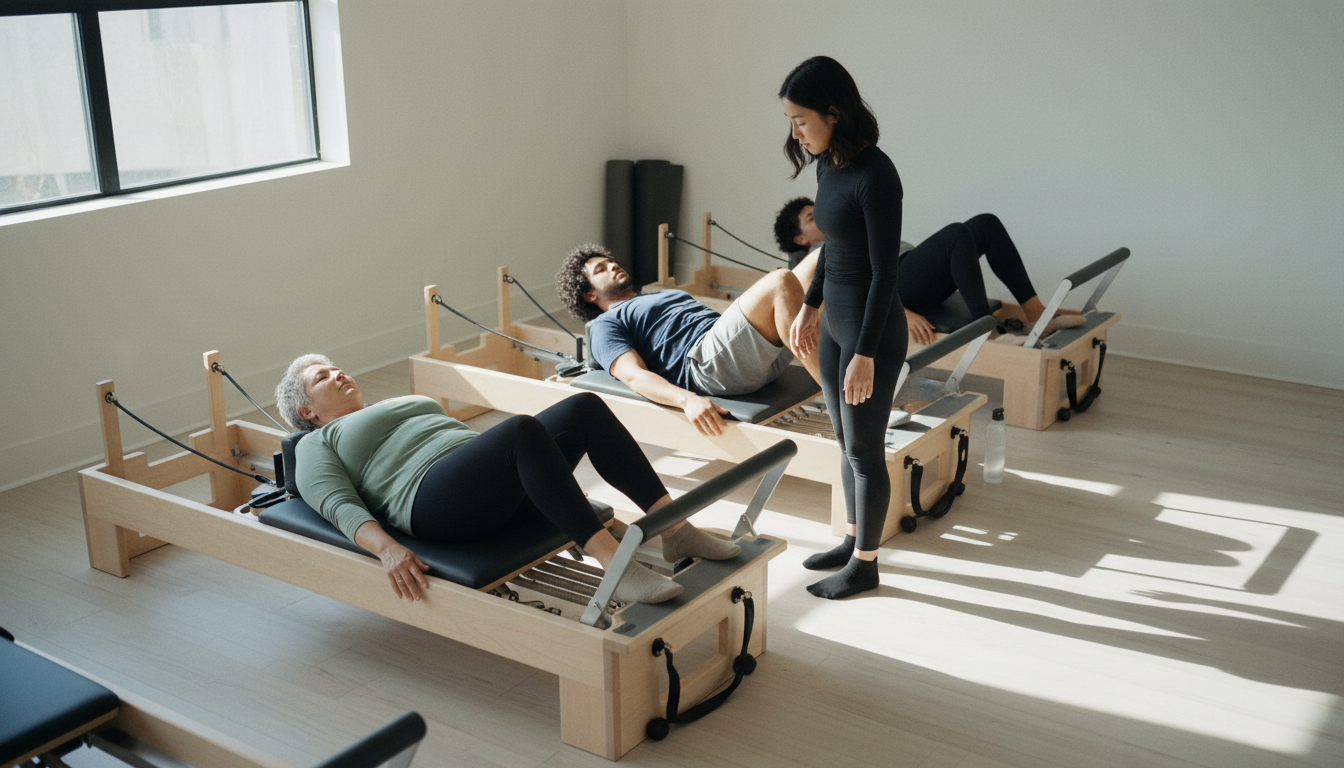

Each reformer class needs its own limit, based on working machines, safe spacing, and how much coaching that level needs. Pair it with a break-even number so you know what a viable class looks like.
A few weeks of occupancy, waitlist, and late-cancellation data shows whether a class has unmet demand or a scheduling problem. Change one thing at a time and measure the result.
A clear cancellation window and an automated waitlist refill empty reformers without manual messages. In bsport, Smart Waitlist moves the next eligible member into the class, and the same rules can run across every location.
Every reformer class has a hard limit: one member, one machine. Once the class starts, any reformer left empty is revenue you can't get back. Managing reformer class capacity means setting the right limit for each class, building your schedule around real demand, and getting canceled places back to members quickly, while keeping the personal attention members pay for.
This guide covers how to set class sizes, which numbers to track, how to plan your timetable around demand, and how waitlists and cancellation policies keep your reformer classes full.
Why reformer class capacity requires careful planning
Reformer capacity is fixed by your equipment, so every planning decision has a direct effect on revenue and on the class experience.
In a mat class, you can usually fit one more person by moving a few mats. Reformer classes work differently. Each participant needs a dedicated machine, so capacity is set by the number of working reformers you have, and that number stays the same on your busiest Monday evening.
That makes every place valuable. A reformer that sits empty during a class is income you can't recover once the class has passed. Across a week of 30 or 40 classes, a couple of empty machines per session adds up quickly.
Good capacity management balances three things: profitability, safe movement, and the instructor attention that brings members back. Members choose reformer Pilates for guided, small-group sessions where someone notices their form, and that experience is worth protecting as classes fill.
How to determine the right reformer class size
The right class size depends on your space, your equipment, the class level, and the occupancy each class needs to cover its costs.
Start with your available equipment and studio space
Your maximum capacity starts with the number of working reformers, then gets adjusted for the room.
- Count only reformers that are in service. A machine waiting on a new spring or strap shouldn't be bookable.
- Leave enough space between machines for members to get on and off safely and for the instructor to walk the full room.
- Factor in ventilation, accessibility, and any local occupancy rules that apply to your premises.
The number of reformers that physically fit in a room is often higher than the number that makes for a comfortable class. If your instructor can't reach the back row to adjust a foot position, the room is over capacity, whatever the floor plan says.
Consider the class level and teaching format
Set capacity by class type, because one limit across the whole timetable rarely fits every class.
- Beginner classes: smaller groups, since new members need more cueing, setup help, and spring changes
- Intermediate and advanced classes: closer to full room capacity, since members know the equipment and need less hands-on correction
- Rehabilitation-focused or technique-led classes: the smallest groups, where individual modifications are the point of the session
Instructor experience matters too. A newer teacher may run a stronger class with 8 members than with 12, while a senior instructor can comfortably manage a full room of regulars. Class complexity and the amount of form correction involved should shape the number as well.
Calculate the minimum occupancy each class needs
Once you know the maximum, work out the minimum number of occupied reformers a class needs to cover its costs.
- Add up the cost of running one class: instructor pay, a share of rent, equipment depreciation and maintenance, and other overhead.
- Divide that cost by your average revenue per booking.
- The result is your break-even occupancy.
If a class costs $150 to run and your average revenue per booking is $25, you need 6 occupied reformers to break even. In a 12-reformer room, that's 50% occupancy before the class makes any money.
That gives you three numbers for every class: maximum capacity, break-even occupancy, and target occupancy. Your target sits between the two, high enough to be profitable and with enough headroom for waitlist promotions.
Pricing and capacity work together. If a class only breaks even when it's nearly full, the answer may sit in your pricing rather than your timetable. For the full cost breakdown, read our guide to balancing equipment costs and class size in a reformer Pilates studio.
Track reformer class occupancy and demand
Occupancy data shows which classes have more demand than places, and which have places members aren't booking.
Occupancy rate is the percentage of available reformer places that are booked or attended in a class. Track both. Booked occupancy shows demand, while attended occupancy shows what actually happened in the room.
Compare performance by class, day, time, instructor, level, and location. A 7am class averaging 60% might look weak until you see it runs at 95% on Tuesdays and 30% on Fridays.
| Indicator | What it tells you |
|---|---|
| Average occupancy | How full each class runs over time |
| Actual attendance | How many booked members turn up |
| Waitlist size | Whether demand is outgrowing your current places |
| Waitlist conversion | How often waitlisted members take a freed place |
| Booking lead time | How far in advance a class fills |
| Late cancellations and no-shows | How many places are lost too late to refill |
| Revenue per class | Whether a class covers its costs |
| Members who can't book suitable sessions | Where loyal members are repeatedly missing out |
Consistently full classes with long waitlists usually point to unmet demand. Repeated empty places can reveal a timing problem, a pricing issue, or a cancellation policy that needs work. Review several weeks of data before you change the timetable, so one unusual week doesn't drive the decision.
bsport brings booking, attendance, waitlist, and revenue data together in one place, with built-in AI summaries and recommendations that help you spot demand patterns sooner. The timetable decisions stay with you.
Build your reformer class schedule around member demand
Your booking and attendance history is the most reliable guide to when members want to train.
Identify peak and quieter periods
- Use booking and attendance history to see when members actually come to class
- Look for patterns that repeat across several weeks, rather than relying on assumptions about popular times
- Account for seasonal shifts, like summer dips or January surges, and for differences between locations or member groups
Adjust the timetable gradually
- Add sessions next to time slots that regularly hit capacity and build long waitlists
- Merge or move classes that stay quiet week after week
- Schedule beginner reformer classes at accessible times, so new members can build a regular habit
- Stagger levels and formats, so similar classes don't compete for the same members
- Leave time between classes for cleaning, equipment checks, arrivals, and instructor breaks
- Test each change for a few weeks, then compare occupancy, revenue, and member feedback before you make it permanent
For more on structuring your week, see our guide on how to build the perfect class schedule for your studio.
Manage waitlists, cancellations, and no-shows
Your waitlist and cancellation policy decide how many canceled places make it back into the schedule before class starts.
Use waitlists to refill canceled places
An automated waitlist offers a freed reformer to the next eligible member, with no calls or messages from your front desk. To make it work well:
- Set a clear queue order and notification method
- Choose a response window, plus a cutoff after which places are no longer promoted
- Explain the process to members, so they know how and when they might get a place
- Track how often waitlisted members accept a place, so you can see whether the process is working
In bsport, Smart Waitlist handles this automatically. When a member cancels, the next eligible member on the waitlist moves into the class, so popular sessions stay full and your team doesn't manage the queue by hand.
Create a fair cancellation policy
- Set a cancellation window long enough to give you a realistic chance to refill the place
- Send automated reminders and make cancelling easy in the app, so members release places earlier
- Apply late-cancellation and no-show rules consistently, with room for discretion in genuine emergencies
- Review your cancellation data regularly and adjust the policy if places aren't returning to the schedule
For unlimited memberships, bsport's no-show management can apply a penalty automatically after a set number of missed classes, either a temporary block on the pass or a deduction from the member's balance. Members who know a missed class has a cost tend to cancel earlier, which gives the waitlist time to work.
Keep the member experience strong as classes fill
Higher occupancy only helps when members still get the attention and access they came for.
Aim for the right occupancy for each class, which is rarely 100% at any cost.
- Make sure instructors can still observe everyone, correct form, offer modifications, and support newcomers
- Write clear class descriptions and level requirements, so members book classes that suit them
- Offer introductory sessions or a beginner pathway for members new to reformer Pilates
- Ask instructors and members for feedback on classes that feel crowded, rushed, or hard to get into
With Spot Selection in bsport, members can choose their reformer when they book, which makes arrival simpler and helps a full class feel organized.
Manage reformer capacity across multiple locations
Shared standards and central reporting keep a multi-location brand consistent, while each studio adapts to its own space.
- Set shared booking windows, waitlist rules, cancellation policies, and reporting standards across the brand
- Let capacity limits reflect each location's room size, equipment, instructors, and local demand
- Compare occupancy and waitlist data across studios to see where to adjust schedules or add capacity
A connected studio management platform gives you central oversight while each location responds to its own community. The Frame Studio, a community-focused reformer Pilates brand in Hamburg and Berlin, runs both locations through one bsport setup, with a parent account and two sub-studios managed centrally.
“The booking platform is the heart of the entire operation.”
— Lino, co-founder, The Frame Studio
Make every reformer place count
Thoughtful class limits, demand-led scheduling, reliable waitlists, and clear cancellation rules help you protect both your margins and your members' trust. When booking, attendance, and waitlist data sit in one system, you can make those decisions with confidence, without spreadsheets or guesswork.
bsport keeps bookings organized, refills canceled places, and shows you where demand is growing, so you can manage reformer class capacity as your studio grows.
See how bsport's Pilates studio software helps you manage capacity, refill canceled places, and understand demand, so your team can keep classes running smoothly without losing the personal experience members value.


FAQ Key things to know
What is a reformer Pilates class?
A reformer Pilates class is a Pilates session performed on reformer machines, which use a moving carriage, springs, straps, and a footbar to support or challenge movement. Pilates is the broader method: mat classes rely on body weight and small props, while reformer classes use the machine for adjustable resistance.

Why is reformer Pilates suddenly so popular?
Its low-impact format, adjustable resistance, guided small-group setting, and visibility on social media have broadened its appeal. For studios, that popularity shows up as heavier booking demand, especially at peak times, which makes scheduling and capacity planning more important.
How can studios make reformer classes beginner-friendly?
Run beginner-level classes with lower capacity limits, offer intro sessions, and write clear class descriptions so newcomers know what to expect. Extra instructor attention in the first few classes helps new members start safely and keep booking.
What are the downsides of offering reformer classes?
From a studio owner's perspective, reformers need a significant upfront investment, ongoing maintenance, and dedicated floor space. Capacity is fixed by the number of machines, so empty places cost more and need careful management.