
You Can Open a Fitness Studio Quickly, But Building a Strong Positioning Takes Strategy
Today, you can open a fitness studio relatively quickly. Find a space, buy equipment, plan classes, build a website, launch social media—many people can manage that.
What’s much harder is creating a profile that is instantly understandable, consistently reflected in daily operations, and financially sustainable in the long term.
That’s exactly where your fitness studio positioning comes in. Not as a “marketing topic” to tackle sometime after opening, but as a strategic decision that influences everything: pricing, occupancy, member retention, market perception, and whether you can grow later without compromising who you are.
In this article, I’ll show you why positioning is a true success lever when opening a studio—and how to build it so it doesn’t just sound good on paper but becomes tangible in everyday studio life.
Why Positioning Is More Than Marketing
Many founders associate positioning with colors, logos, and Instagram feeds. That’s understandable because positioning is often first seen externally.
But in the boutique space, a strong brand rarely comes from design alone—it comes from clarity:
- What do you offer?
- For whom?
- Why exactly this way?
- What makes the experience with you different?
Strong positioning answers three core questions every member asks (consciously or unconsciously):
- Is this made for me?
- Will I get an experience here that I can’t get elsewhere?
- Is it worth the price—and will I stick with it?
If you can consistently answer these questions, marketing becomes easier. Without that clarity, marketing becomes expensive.
Positioning as a Business Decision
Your studio’s positioning determines not only how you sound, but how you earn revenue. It influences:
- Your business model: drop-ins, packages, memberships, hybrid offers
- Your occupancy strategy: peak times, class rotation, waitlists, capacity
- Your cost structure: trainer profiles, training formats, space design, technology
- Your forecasting: retention, cash flow, revenue planning
A Boutique Studio Example
If you want to be “for everyone,” you usually need:
- More class variety
- More formats
- More trainer profiles
- More explanation in marketing
That creates complexity—and complexity eats margins.
A clearly positioned studio can plan with more focus, sell more efficiently, and deliver more consistently.
This doesn’t mean niche automatically means small. It means you become financially stronger when you serve the right audience deeply instead of serving many audiences halfway.
Impact on Pricing Strategy and Member Retention
In boutique fitness, price is never “just” price. It’s a signal.
And that signal only works when positioning and experience align.
Clearly Positioned
You’re selling a specific result or feeling, such as:
- A stronger back
- Better athletic performance
- Reduced stress
Packaged in a recognizable experience. The price feels justified.
Poorly Positioned
You end up competing on:
- More classes
- Lower prices
- Closer location
That’s rarely where boutique studios win.
Member retention also depends heavily on whether your studio plays a clear role in members’ minds:
“This is my place, my workout style, my community.”
That creates strong retention—and reduces pressure to constantly acquire new leads.
Positioning in Boutique Fitness Studios
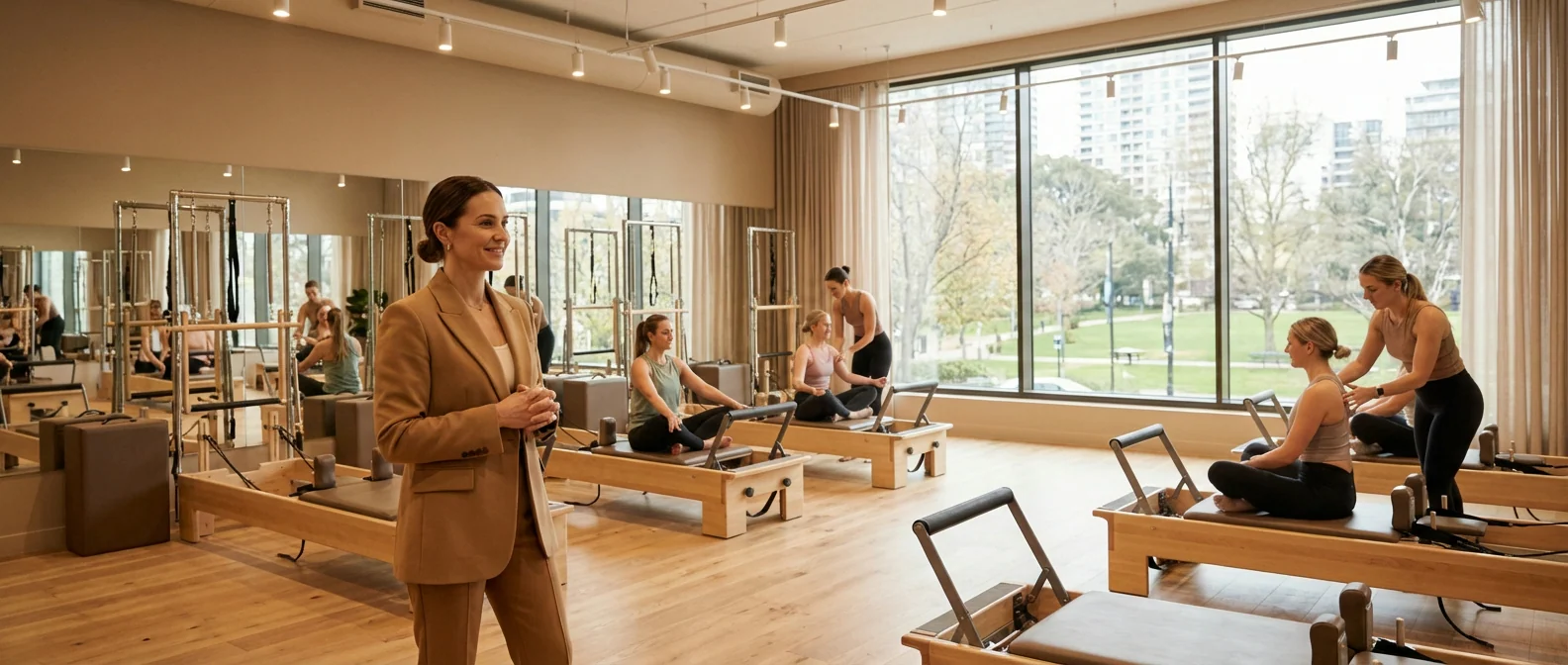
Boutique doesn’t mean “small.” It means intentionally curated.
You’re not selling “equipment + space.”
You’re selling a training experience that feels cohesive from first contact to checkout.
Key Building Blocks of Boutique Positioning
- Target audience: Who should instantly feel addressed—and who intentionally shouldn’t?
- Offer / format: What training methodology is your core?
- Experience: What does it feel like in your studio?
- Promise: What transformation do you deliver?
- Proof: Why is it credible?
This is where your fitness studio concept and positioning become inseparable.
Your concept is simply your positioning brought to life through space, offers, and operations.
Thinking About Target Audience, Experience, and Community Together
Many founders start with demographics (“women 25–45”), move to offers (“yoga + functional training”), and hope the rest falls into place.
Boutique studios perform better when target audience, experience, and community are planned as one system.
Ask Yourself:
- What is their daily reality?
- What barriers do they face?
- What motivates them?
Then Design:
- Booking
- Arrival
- Participation
- Feedback
- Rebooking
Practical Example
If your studio targets performance-driven professionals, then time is part of the product.
The experience must feel frictionless:
- Fast check-in
- Clear class levels
- Reliable trainer communication
- Easy rescheduling
Otherwise, the experience doesn’t match the positioning—and suddenly the price feels too high.
That’s why positioning isn’t just story.
It’s system.
Differentiation in a Saturated Market
“The market is crowded.”
You hear this often when someone wants to open a fitness studio.
Partly true.
But the deeper truth is:
The market is full of studios that feel interchangeable.
Differentiation doesn’t come from inventing something completely new.
It comes from:
- Clarity
- Consistency
- Recognizability
You don’t need to be louder.
You need to be clearer.
Common Positioning Mistakes in New Studios
Target Audience Too Broad
“For beginners and advanced.”
“For all age groups.”
“Strength, endurance, mobility, yoga.”
These statements sound nice—but they don’t help anyone decide.
A broad audience leads to:
- More explanation needed in marketing
- More mixed class levels
- Weaker belonging
- Price comparison with cheaper competitors
Unclear Communication + Inconsistent Experience
Even if positioning looks clear on paper, it can fall apart operationally.
Common examples:
- Online feels premium, in person feels chaotic
- Trainers communicate differently
- Booking feels complicated
- Website promises structure, classes feel random
Members notice these disconnects.
And disconnects cost trust.
How Structured Operations Support Clear Positioning
This is where it gets interesting:
Positioning is strategy.
But it only works when operations support it.
A boutique studio promising high-end experiences must deliver different standards than one promising accessibility.
In both cases:
The experience must match the positioning.
That requires structure.
Technology as an Enabler of Consistency
Consistency becomes difficult when too much is handled manually.
Common time drains:
- Bookings via messages or spreadsheets
- Confusing waitlists
- Inconsistent payments
- Different communication depending on staff
An all-in-one studio management platform helps operationally secure your positioning through:
- Unified booking systems
- App + website integration
- Clear credit rules
- Membership management
- Waitlists
- Communication workflows
This isn’t just technology.
It’s part of your brand.
For members, smooth operations are part of the product.
Growing Without Losing Your Identity
Many boutique founders dream of growth:
- A second location
- More classes
- More trainers
- Maybe franchising
This only works if your identity doesn’t depend on individual people or improvisation.
Growth Without Losing Profile Requires:
- Defined standards
- Data usage
- Established systems
- Intentional member journeys
Practical Tip
Define early which 3–5 things must always stay the same, regardless of trainer or location.
Usually these are basics like:
- Greeting style
- Class start
- Coaching tone
- Music level
- Closing ritual
- Post-class communication
Conclusion
Clear positioning is not a nice-to-have when launching a fitness studio—it’s a business driver.
It influences:
- Pricing strategy
- Member retention
- Visibility in a crowded market
The sharper your positioning, the easier marketing, sales, and class occupancy become—and the more consistent the member experience feels.
What matters most is that positioning isn’t only communicated.
It must be lived daily through:
- Standards
- Clear processes
- Smooth booking
- Seamless payments
Want to Build Your Boutique Fitness Studio with a Clear Identity?
Book a demo and discover how bsport helps you consistently implement both positioning and operations.


.jpg)