How to open a Pilates studio: Startup costs, equipment & business planning


A mat-based Pilates studio can launch for far less than a reformer studio, where commercial machines designed for studio use cost around $3,000 to $6,000 each, according to BASI Systems, a leading Pilates equipment manufacturer. Getting clear on your model early is not just a branding decision; it shapes your entire financial plan, space requirements, and long-term revenue ceiling.
The wrong space can mean reformers that do not fit safely, floors that cannot bear the load, or rent that outpaces what your class sizes can realistically cover. Negotiating the right lease with flexibility built in gives your studio the breathing room it needs to grow.
Managing class bookings, memberships, instructor schedules, and payments from day one requires a reliable system built for studios, not a generic tool adapted to fit. The right software keeps your member experience consistent and your administrative overhead low, from your first founding member sign-up through every class that follows
Getting started: the essential steps of starting a Pilates studio
Every Pilates studio that runs well started with a clear plan. Not necessarily a perfect one, but a grounded one. Before you look at spaces or price out equipment, you need to understand what kind of studio you are opening and whether the numbers can realistically work.
Here’s what you need to do to get started:
Craft a clear and sustainable business plan
A Pilates studio business plan does not need to be a formal document written for investors. However, it does need to answer a few non-negotiable questions:
- Who is your target member?
- What will you charge?
- What are your monthly fixed costs?
- How many clients do you need to cover those costs?
In answering those questions, you should come up with:
- Startup cost estimates: Cover equipment, build-out, legal fees, software, and an operating buffer for at least the first three months before revenue stabilizes. A mid-sized reformer studio typically requires from $50,000 to $100,000 or more to open.
- Revenue projections: Model out different scenarios: a conservative class fill rate, a realistic one, and your break-even threshold.
- Your target audience: Define who you are building for. Age range, fitness background, price sensitivity, and what they’re looking for in a studio are all things that’ll shape your decisions around branding, class formats, and pricing.
- The competitive landscape: Research existing Pilates and boutique fitness studios in your area. Identify gaps in the market you can genuinely fill rather than trying to replicate what already exists.
Choose between a mat-based or machine-based model
This is the decision that affects everything else, from planning to branding. A mat Pilates studio is far more accessible to open, for example. It requires minimal equipment and often less space compared to a reformer studio, which means a lower upfront investment.
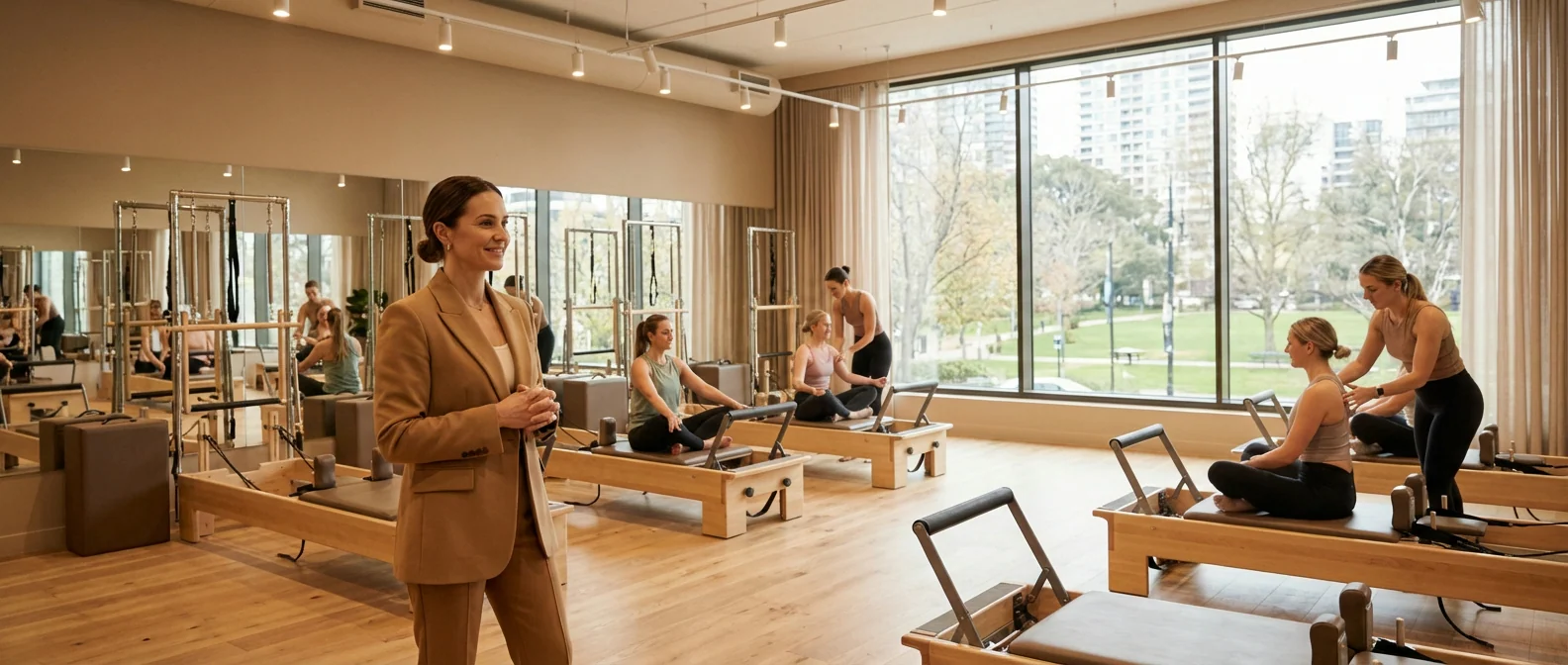
Reformer studios, on the other hand, come with higher upfront costs due to space requirements and equipment needs. Professional reformers designed for studio use cost around $3,000 to $6,000 each, and a studio with 10 to 12 machines represents a significant hardware investment before you account for build-out, props, and supporting equipment. Each machine also requires 18 to 24 inches of clearance on all sides for safe instructor access, which means your square footage needs are larger and your rent is higher by default.
Neither model is better. They just serve different markets and require different operational approaches. What matters is that you choose intentionally, with a clear understanding of the financial commitment each one requires.
Navigating the logistics of opening a Pilates studio
Once you have a business model in place, the next phase is finding the right space and equipping it properly. These are often the most stressful parts of the process, but both become easier once you know what to look for.
So, what exactly do you need to look for?
The right location and space for your Pilates studio
Your studio’s location needs to work for your target members first. Think about where they live, work, and already spend time, and whether they can realistically get to you before or after their day. Visibility and ease of access matter more than you might expect for a boutique studio, where much of early growth comes from foot traffic, local visibility, and word of mouth.
Beyond foot traffic, the physical space itself needs to meet some specific requirements:
- Floor load capacity: Reformers are heavy, and a studio full of them adds significant weight per square foot. If you’re going with a reformer business model, you’ll want a structural engineer to assess the floor before you sign the lease.
- Ceiling height: A minimum of 9 to 10 feet is recommended to allow for comfortable movement and any wall-mounted or Cadillac equipment.
- Ventilation: Pilates is a low-sweat, high-focus practice. Your members will notice immediately if the air quality is poor, so you’ll need to make sure the space is well ventilated.
- Layout flow: A well-designed space allows instructors to move between machines easily during class and gives members enough room to feel comfortable rather than cramped. The square footage and layout should be able to accommodate your intended class size.
The layout and flow of the space add another layer of complexity if you’re going with a reformer business model. A studio with reformers needs to cover an average of 1,500 square feet, though working with 400 to 800 square feet is possible with careful layout planning.
The necessary equipment
Your pilates equipment is your primary revenue-generating asset, and outfitting your space properly is one of the most significant investments you'll make. Whether you're opening a reformer or mat studio, prioritize durability over price. Cheaper items break down faster, and equipment downtime means canceled classes and a disrupted member experience.
When planning your equipment needs, keep the following in mind:
- Reformer studio essentials: Reformers will be your biggest single expense. A high-quality commercial reformer typically ranges from $3,000 to $8,000. You'll also want to account for additional studio equipment in your initial plan. Cadillacs (trapeze tables) usually run between $1,800 and $5,000, while Wunda chairs, spine correctors, and barrels generally cost between $1,000 and $2,500 each.
- Mat studio investments: While your initial investment is lower, high-quality mats, bolsters, resistance bands, and props still add up. Focus on commercial-grade equipment that can withstand heavy daily use without showing wear quickly. Commercial mats usually cost $50 to $120 each, while premium magic circles, blocks, and bands add another $15 to $50 per station.
- Manufacturer financing: Reputable brands like Balanced Body, BASI Systems, and Merrithew offer industry-standard equipment. Many of these manufacturers provide studio financing programs to help spread the upfront cost over time, so you aren't draining your capital before you've even opened your doors.
- Ongoing maintenance reserves: Regardless of your studio's format, build a maintenance fund into your monthly budget from day one. Equipment is a depreciating asset. Springs wear out, upholstery degrades, and carriages require realignment. You should budget roughly $150 to $250 annually per reformer for standard upkeep. None of it's optional.
Setting up your operational backend for a smooth launch
The operational side of opening a Pilates studio tends to get deprioritized because it feels less urgent than finding a space or buying equipment. But your software, scheduling, and payroll systems need to be in place before your first member walks through the door, not after.
Here’s what you need to do to guarantee a smooth launch:
Choose the right management and booking software
Running a Pilates studio on spreadsheets and manual bookings is a short path to administrative chaos. You need a fitness software platform that handles class scheduling, membership management, payment processing, and member communication in one place, reliably and without constant manual intervention.
For a reformer studio, this is especially important. When your capacity is fixed by the number of machines on the floor, booking accuracy matters. Overbookings, missed cancellations, and manual waitlist management are not just inefficient; they directly affect revenue and member experience.
Streamline class schedules and instructor payroll
Your class timetable is one of the most important things you will build before launch, and it is worth spending real time on. A well-structured studio schedule reflects when your target members are actually available, distributes demand across the week, and gives each instructor a workload that is sustainable without being underutilized.
For payroll, clarity matters from the very start. Define your instructor compensation model, whether it’s a flat rate per class, a base plus commission, or a package rate, and make sure your software can track and automate it. Instructors who feel fairly and reliably compensated stay longer, and retention at the instructor level directly affects retention at the member level.
Don’t forget to build buzz and market your new Pilates studio
Opening day won’t fill itself. The studios that launch with momentum are the ones that start building an audience weeks or months before they open, not after.
Here’s how to build that buzz:
Create an irresistible pre-opening offer for founding members
A founding member campaign serves two purposes: it generates early cash flow to offset equipment and build-out costs, and it builds a community of invested members who feel connected to your studio from the beginning.
Founding member offers typically come with a significant discount on standard membership rates, limited spots to create urgency, and an early access or opening day event to reward early sign-ups. The key is setting a price that covers your costs while still feeling genuinely valuable to the people who claim it. The fitness software platform you choose should include marketing features and tools that make it easier to manage this part of your launch.
Leverage local partnerships and social media
Paid advertising can wait. In the early stages, local partnerships and organic content will give you a higher return for less spend.
Think about businesses your target member already frequents: physiotherapy clinics, nutritionists, wellness cafes, activewear retailers, and similar complementary services. A cross-promotional arrangement, whether that is co-hosted events, referral cards, or shared social content, puts your studio in front of an already-warm audience.
On social media, start before you open. Document the build-out, introduce your instructors, share your founding member offer, and give people a sense of what your studio will feel like. Instagram and TikTok perform well for Pilates content specifically, and behind-the-scenes content tends to drive more genuine engagement than polished promotional posts.
The last step: Managing the challenges of opening day
Even a well-prepared launch will have a few hiccups, but your team needs to be equipped to resolve any issues quickly. This matters because your new members will form their entire opinion of your studio within the first five minutes of walking through the door.
The goal here is not to eliminate every single potential problem, but to have the systems in place so that things like check-in or payment errors never disrupt that critical first impression.
Here’s how to prepare for the most successful launch possible:
- Run a mock opening week: Avoid scheduling errors, check-in confusion, and payment problems by testing your software early. Go through the booking flow as a member to identify and fix any confusing steps before going live.
- Prepare your team thoroughly: Instructors should know your booking system just as well as their class content. Ensure anyone working the front desk can answer common new member questions without hesitation.
- Perfect the physical space: Since those first few minutes are so important, focus on the free details, like a tidy environment and clear signage for where members should leave their belongings.
- Personalize the class experience: Instructors should always introduce themselves and ask about injuries before class begins. This intentional focus costs nothing but builds immediate trust.
- Prioritize early retention: Member loyalty in boutique fitness is largely decided in their first three classes. Getting those early experiences right is the single best investment you can make before opening day.
Turn your Pilates studio vision into a sustainable reality
Opening a Pilates studio is a significant undertaking, financially, logistically, and personally. But the studios that succeed are not necessarily the ones with the biggest budgets or the most experience. They’re the ones that plan carefully, launch with intention, and build the operational foundations that allow them to focus on what actually matters: the member experience.
The heavy lifting of planning, location, equipment, and systems gets you to opening day. What keeps a studio thriving beyond that is the consistency of the experience you deliver, the community you build, and the operational clarity that lets you make good decisions at every stage of growth.
Ready to get your Pilates studio up and running? Explore how a dedicated management platform can streamline your launch by booking a demo with bsport to see the platform’s intuitive scheduling, admin features, and marketing tools in action.


.jpg)